



TL;DR:
Plakar’s Kubernetes integration now backs up KubeVirt VMs: every disk plus the VM manifest, in one snapshot, consistent across disks. On OpenShift, a new
openshiftpackage keeps restores from doing things you didn’t ask for. Both are free.
OpenShift Virtualization is Red Hat’s packaging of upstream KubeVirt. A VM is a
Kubernetes object, its disks are PVCs, so our Kubernetes integration should have
covered them already. It didn’t: it rejected VolumeMode: Block outright, and
most VM disks are block-mode. That was the actual blocker.
We don’t freeze VMs. KubeVirt does.
A disk snapshotted mid-write may not boot. A VM with three disks snapshotted a
few seconds apart is worse. KubeVirt already solves this: its
VirtualMachineSnapshot freezes the guest through the qemu guest agent and
coordinates every disk. So we drive it instead of reimplementing it.
The flow: Plakar requests a VirtualMachineSnapshot, a short-lived pod streams
each disk out as raw blocks, and Plakar dedups, compresses and encrypts it into
the same snapshot as the VM manifest. Restore goes the other way: fresh PVCs,
data written back, manifest applied, into the original namespace or a new one.
No guest agent, no freeze: Plakar gives up after 10 minutes instead of waiting forever. Install the agent.
OpenShift: restore what you backed up, nothing more
Backup stays a complete record. Filtering happens on restore, because some
objects come with side effects: restoring a BuildConfig re-triggers a build, a
Route reassigns a host, SecurityContextConstraints and OAuth tokens belong
to the cluster. The openshift package skips them. Its helper pod sets its
security context explicitly, and it matches OpenShift’s default restricted SCC:
OpenShift doesn’t let pods add capabilities anyway.
Try it
Pre-built packages need a free Plakar account:
$ plakar login
$ plakar pkg add k8s
$ plakar backup k8s+vm:/vms/my-vm
On OpenShift:
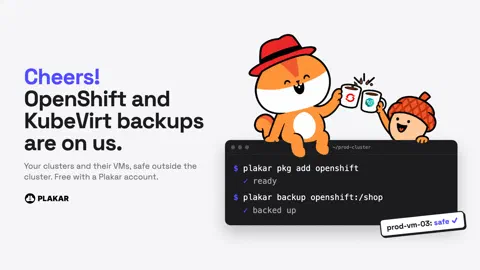
$ plakar pkg add openshift
$ plakar backup openshift+vm:/vms/my-vm
RBAC roles and options are in the Kubernetes docs.
How it ships
KubeVirt support lives in the Kubernetes integration, which is
open source (ISC).
The openshift package is not open source, but it is free for everyone in the
Plakar community: create a free account, run plakar login, install it.
Running VMs on Kubernetes? Break it and tell us on Discord.