Managing Organizations
#Organizations partition a Plakar Control Plane instance into isolated administrative domains. They allow a single deployment to manage multiple teams, business units, customers, or environments while keeping their configuration and operational data separate.
Every Plakar Control Plane deployment contains a root organization that is created during the initial setup (enrollment). Additional organizations can be created beneath it, forming a hierarchy. Each organization has a single parent and may contain any number of child organizations.
For example:
Root
├── AWS
│   ├── S3
│   └── EC2
└── VMware
    ├── Production
    └── Development
This hierarchy can be extended to any depth, allowing organizations to be structured in whatever way best matches your operational or administrative requirements.
Organization isolation
#Every object in Plakar Control Plane belongs to a single organization. This includes users, inventories, resources, secret providers, apps, policies, scheduled tasks, job history, and most other configuration and operational objects.
Objects are scoped to the organization in which they are created. Users operating within an organization can view and manage only the objects that belong to that organization. Users with access to a parent organization can switch to one of its child organizations to manage the objects within that organization.
For example, if separate AWS and VMware organizations exist beneath the root organization, users operating in the AWS organization cannot view or manage VMware inventories, resources, jobs, or other objects. Likewise, users in the VMware organization cannot access AWS organization.
Organization context
#Users always operate within the context of a single organization. The selected organization determines which objects are visible and which administrative operations can be performed.
A user may be granted access to one or more organizations. Users with access to multiple organizations can switch between them at any time. For example, a user with access to both the AWS and VMware organizations can switch between those organizations, but cannot access the root organization unless they have also been granted access to it.
Users with access to a parent organization can also switch to any of its descendant organizations. For example, an administrator operating in the root organization can switch to the AWS or VMware organization to manage its objects directly.
Root organization
#The root organization has visibility across the entire organization hierarchy and can operate within any descendant organization by switching context.
Although the root organization can administer child organizations, objects remain owned by the organization in which they were created. This isolation allows multiple independent administrative domains to coexist within a single Plakar Control Plane deployment while remaining centrally managed.
User roles
#A user’s permissions within an organization are determined by the role assigned to them for that organization. The same user may have different roles in different organizations. For example, a user may be an Administrator in the AWS organization while being assigned the Backup Operator role in the VMware organization.
See Managing Users for information about available roles and how they are assigned.
Managing organizations
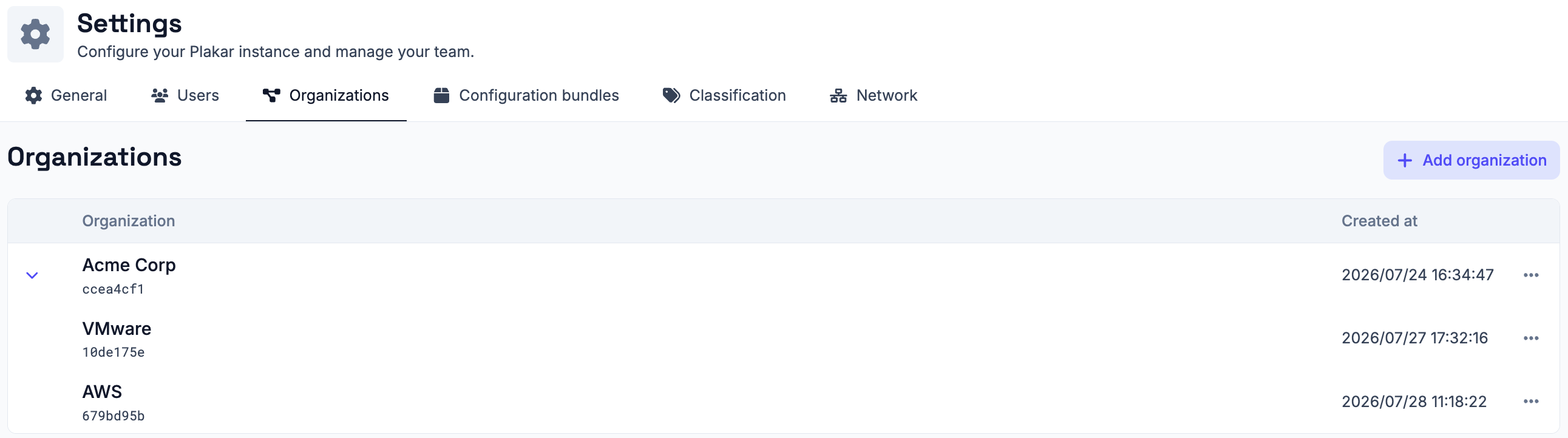
#Organizations are managed from Settings → Organizations. This page lists every organization you have access to and allows you to create new organizations.
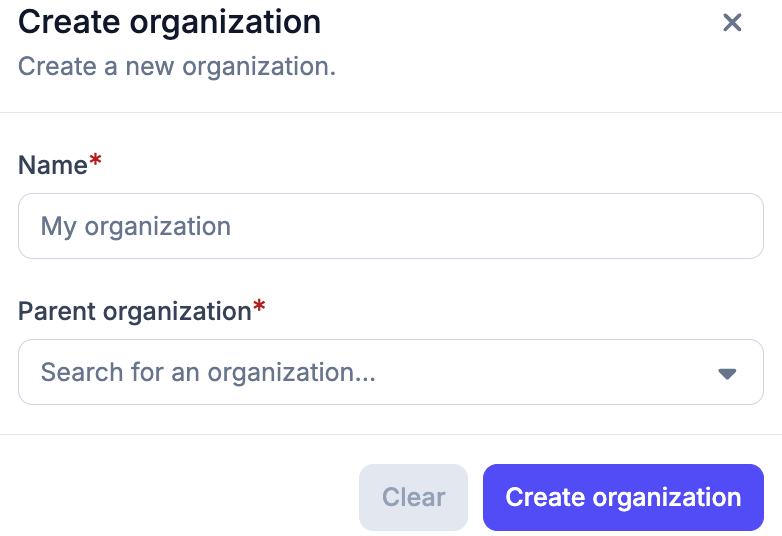
To create an organization, provide a name and select its parent organization. New organizations are added beneath the selected parent, allowing you to build an organization hierarchy that matches your operational requirements.
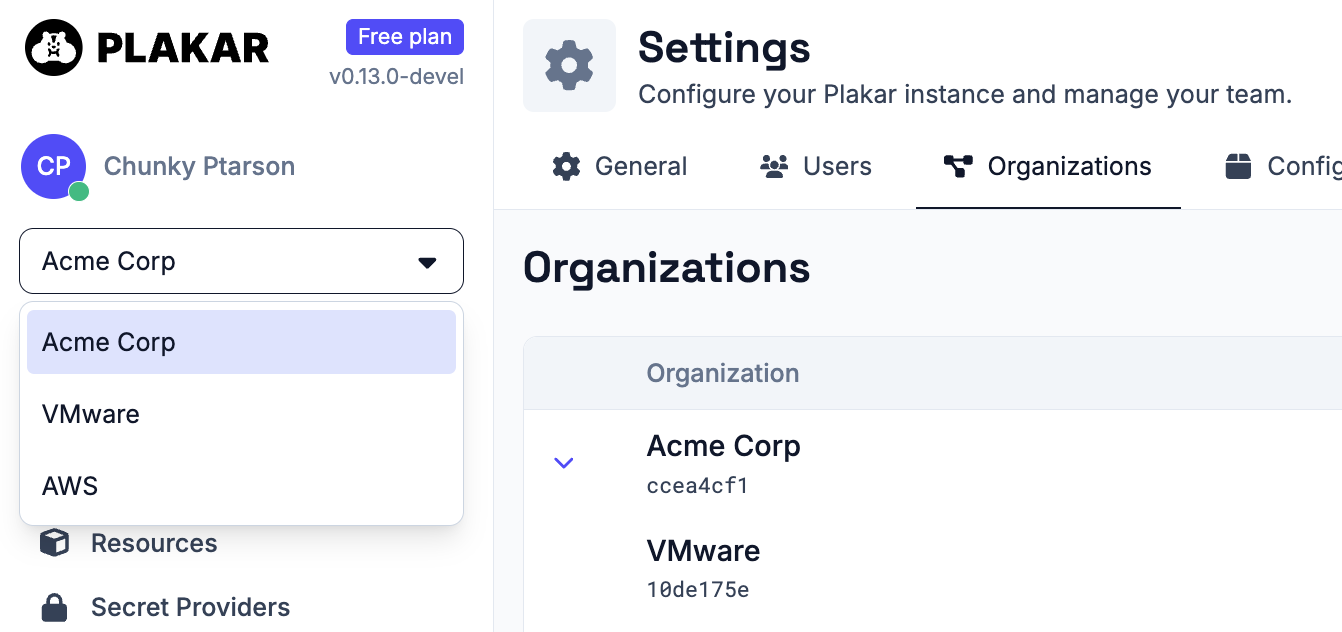
The active organization can be changed at any time from the organization selector in the sidebar. Switching organizations changes the current context, allowing you to view and manage the objects that belong to the selected organization.
Organization details
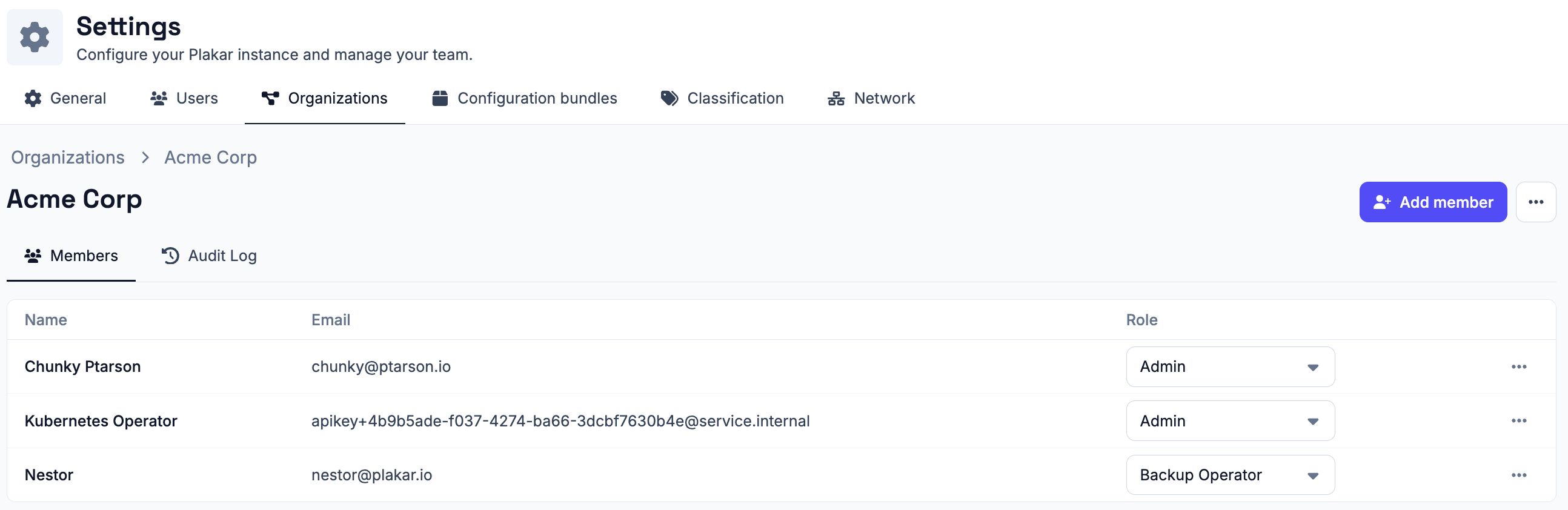
#Selecting an organization opens its management page, where you can manage members and review the organization’s audit log.
Members
#The Members tab lists all users who have access to the organization.
From this page you can:
- Add existing users to the organization.
- Assign or update each user’s role within the organization.
- Remove users from the organization.
Users must be created before they can be added to an organization. See Managing Users for information about creating member and application users.
Audit log
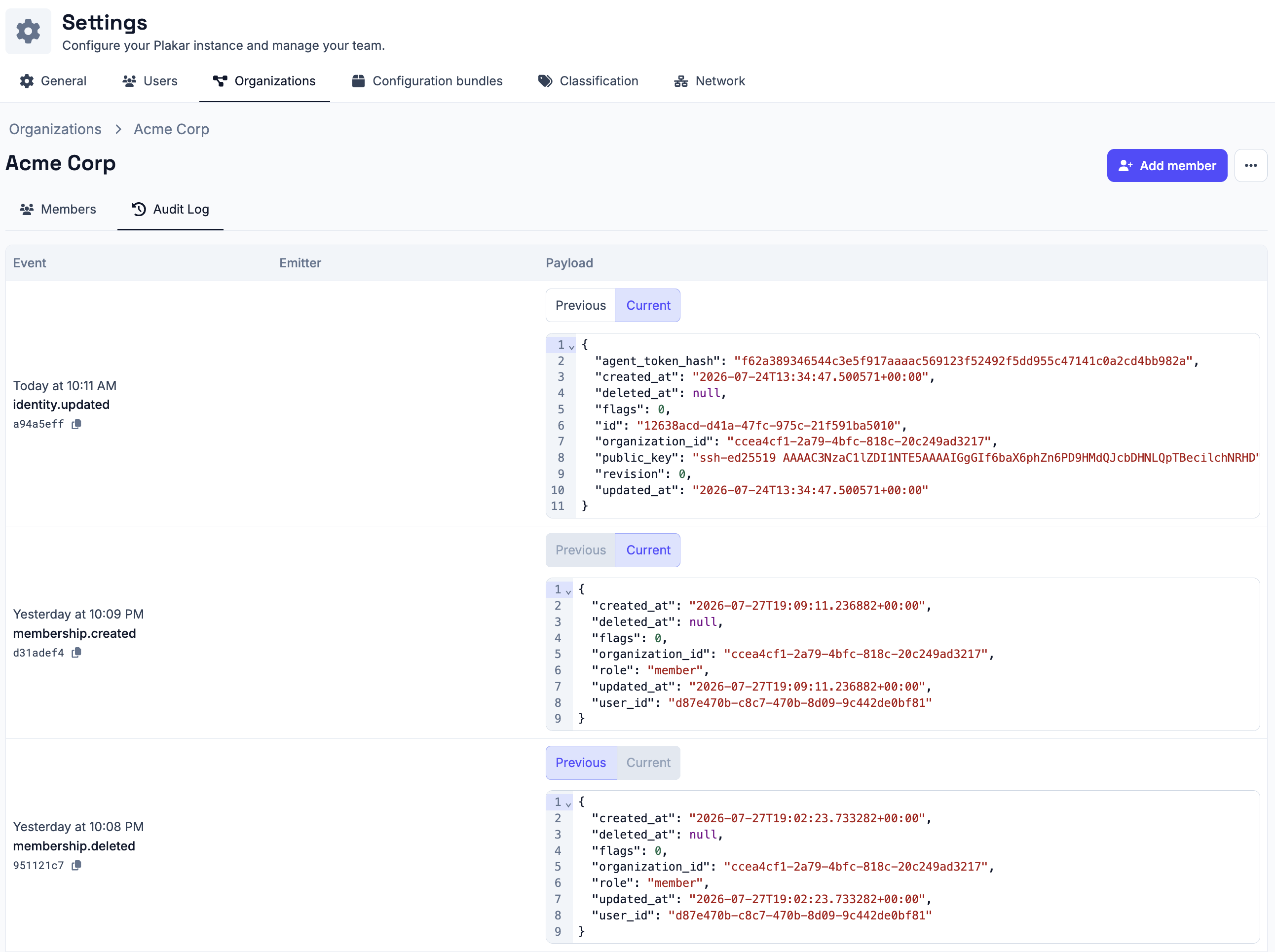
#The Audit Log tab provides a chronological record of activity within the organization. It records administrative and configuration changes, allowing you to review who performed an action, when it occurred, and the changes that were made.